If you need to create an easily editable mark on the surface of the material with excellent quality, high durability and in a low time, it is advisable to use laser technology. In addition to laser marking applications, this technology has successfully established itself in many other industrial applications and is constantly evolving.
Laser source manufacturers are constantly expanding the capabilities of their products and making them more efficient to use for their applications. Pulsed fibre laser sources today can have an average power from several tens to several hundreds of W, a range of pulse frequencies over 1 MHz, thanks to their MOPA architecture they can adjust the pulse length from a few nanoseconds (ns) to below hundreds of ns and are marketed in several variants with different beam quality having different laser footprint size and different energy distribution in it.
Leaving aside the fact that pulsed laser sources are available in several wavelength variations to enable suitable absorption of the laser beam in specific materials, the recent hit is the so-called short-pulse lasers.
These are pulsed lasers with very short pulses in the picosecond (ps) or even femtosecond (fs) range that can deliver tremendous peak power to the material in a very short time. This makes them a very effective tool for creating rich contrast on common materials such as metal or plastic, but they can also affect a range of more exotic materials – such as glass, which is virtually invisible to conventional nanosecond lasers. In fact, due to the high shock load, the very short pulses create a network of tiny cracks in the glass, which, due to the different light scattering, creates easily readable patterns in the surface.
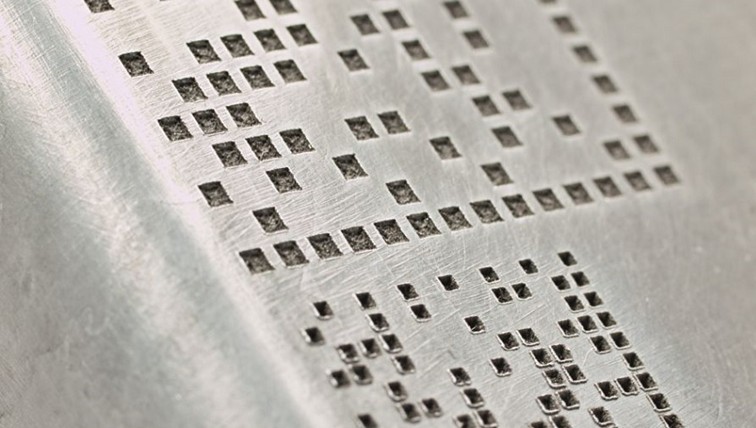
If surface marking moves into the area of sublimation of the material to create highly resistant embossing patterns, short-pulse lasers also achieve much better results here. The edges of the engraved areas are perfectly sharp, because the short beam exposure does not bring with it some unwanted parasitic effects, such as material melting, which creates igneous scales on the edges of the laser-affected area. The deeper engraved markings thus remain clearly legible even in the form of very small patterns.
The disadvantage of short-pulse laser systems, despite their undeniably higher quality of the resulting marking or engraving, is unfortunately the price. In addition to the laser source itself, it is often necessary to use deflection heads capable of positioning the beam accurately enough to unlock the full potential of the device, even at the high beam speeds that short-pulse lasers operate at. Over time, however, as with other initially new technologies, the prices of short-pulse lasers have slowly decreased, making them increasingly affordable to the market.