Laser welding of metals is one of the main and relatively well studied laser applications. Previously, this application in the conventional sense relied mainly on the use of high power continuous lasers together with a process head and associated process optics.
However, pulsed lasers – usually solid-state lasers, combined with a deflection head and F-theta lens – are becoming more and more common for metal welding nowadays. Continuous high-power lasers are, of course, still finding and will continue to find their application, especially in established applications for welding materials with large thicknesses where a high degree of weld-through is required. However, there are also applications where relatively weak metal layers need to be welded and where the above-mentioned lasers are not quite ideal.
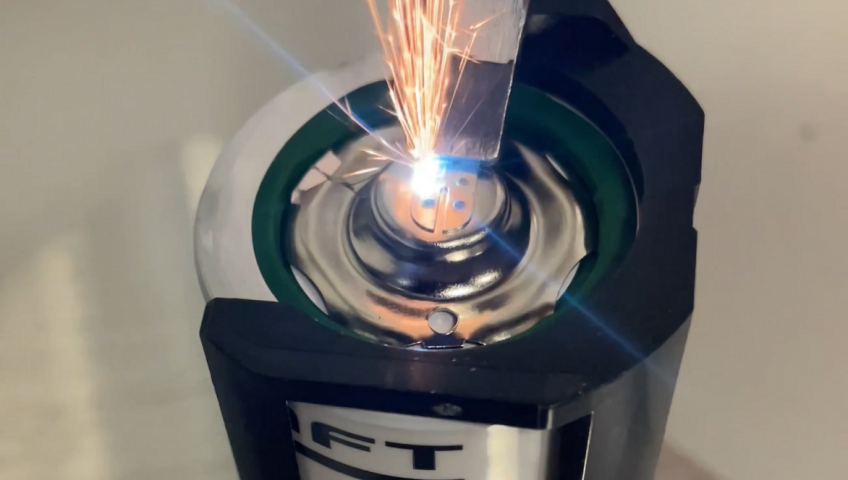
One such case is laser contact welding. This application has recently become a trend also due to the intensive expansion of the use of battery cells as energy sources. E-mobility, as a field, is one of the typical representatives of the use of this application. Not only do the contacts have very small thicknesses, but they are very often a combination of heterogeneous, i.e. different, metallic materials such as Ni + Al or Cu + Al. When welding heterogeneous materials with continuous lasers, intermetallic regions are formed at the junction of the layers, reducing the strength of the weld. Also for this reason, the use of pulsed lasers is preferable in this case. Of course, as in the case of any other welding, good thermal contact of the welded layers, usually supported by a suitable pressure mechanism, is required.
LINTECH uses its know-how to create heterogeneous welds using nanosecond fiber lasers with low average power. These lasers not only can efficiently join even very different materials, but also bring economic benefits, especially compared to high-power continuous lasers. Welds are usually performed as a group of points of specific shape and size in which material is transferred from the upper layer to the lower layer and vice versa. To a lesser extent, melt formation also occurs, which has the effect of suppressing the negative effect of the intermetallic region. Another significant benefit is the very small heat affected area around the weld, which does not deform the thin material and does not affect potentially sensitive components in the vicinity.
Contact welding times are typically in the order of seconds and the achievable weld strength can be up to 900 N in shear and 200 N in market. These results have been repeatedly confirmed in many blast tests carried out. The use of an inert gas protective atmosphere is possible and even advisable, as it improves the weld design and process stability. However, the use of a protective atmosphere is not necessary; the weld still retains its qualities.
We have tested the feasibility of this application many times.