Automotive is nowadays a sector that reaches into all spheres of industry and is on the rise. It also accounts for a large part of our customers for whom we supply single-purpose machines for marking, welding or cutting automotive components. The same is true of our customers in the industrial sector who ask us for glass marking.
Several of our customers have requested contrasting signage on their car windows so that the lettering meets the standards. To be easily visible to the eye, contrasting for reading devices and resistant to abrasion and other stresses. It has to pass through all stages of production without damage, passing through a furnace at more than 700 degrees Celsius and thus fitting into the traceability system. This is where barcode traceability is required.
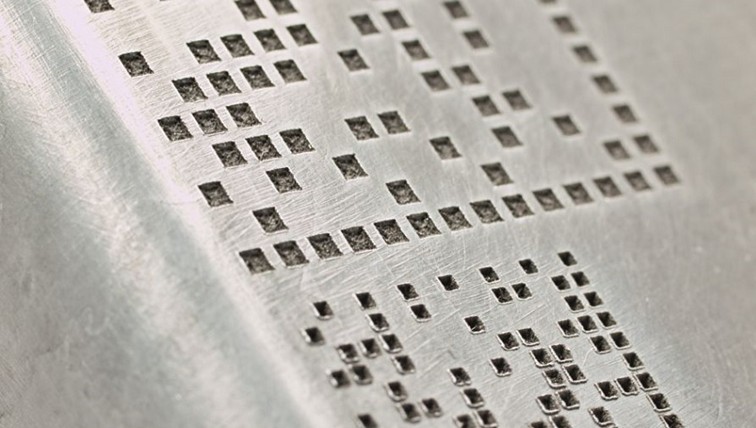
Although the use of a CO2 laser (10600 nm) is still a frequently used form of glass marking, unfortunately, the contrast achieved by this type of technology is very poor or only wrinkles the surface. The marking is then either seen as a set of fine bubbles or indentations. Or it may be completely clear, just embedded below the surface of the glass. This is because the laser vaporizes several layers of material, creating a letter-shaped crater.
The second option was marking with a green laser (wavelength 532nm). In our experience, this laser can mark glass by its thermal influence, so that bubbles are formed in the material due to heat, which refract light in a different way than clear glass. The marking then appears as a contrast and is easily readable even from a distance. This type of marking, however, again only achieves a colour in shades of white, at most slightly grey. It all depends on the thickness of the glass. The more we can heat the glass and create the marking, the more saturated and contrasty it is. Thin glass has a tendency to crack. But we never achieve a black colour. The advantage of this technology is that we can place the marking wherever we focus the laser beam. Levels – we can adjust the height of the marking by continuously moving the Z axis of the laser head. The marking can then be recessed in 10 mm thick glass at a depth of 5 mm, for example. In this way, a so-called plasticity of the marking can be created, where by creating different levels the marking can appear as 3D.
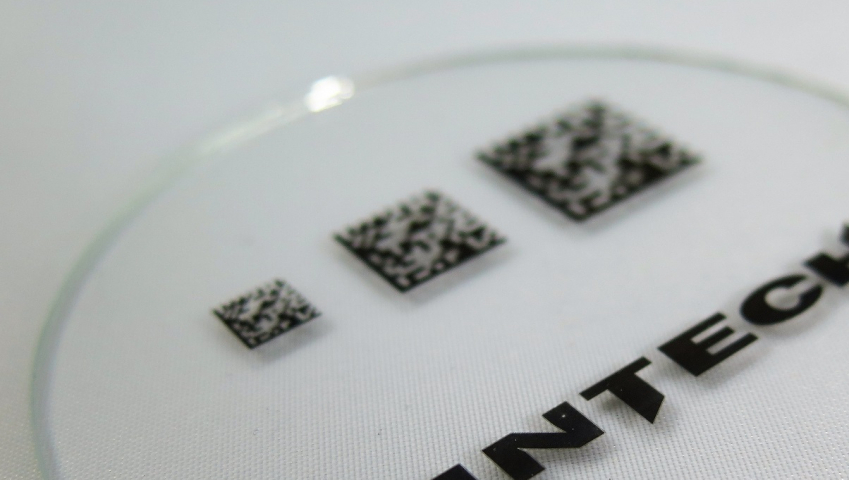
To solve the customer’s requirements, we had to use a third, also widely used marking method, this time with a fiber laser with a wavelength of 1064nm. This is called additive glass marking. For the contrasting black marking, a plastic PET tape had to be used, which was coated with a special titanium alloy layer. It was then applied to the surface of the glass and fused to the targeted areas by high temperature heating with a laser beam (at the points of influence). In this way, any description can be achieved, limited only by the width of the tape, which can vary according to the manufacturer. The laser is capable of creating datamatrix codes, logos, raster images or vector graphics. The used tape segments must then be cut off or the remaining areas further vaporized by selecting a different or smaller graphic. This label is high contrast, abrasion resistant and very tough when subjected to sharp objects. Since it is created at tremendous temperatures, it is also very temperature stable.
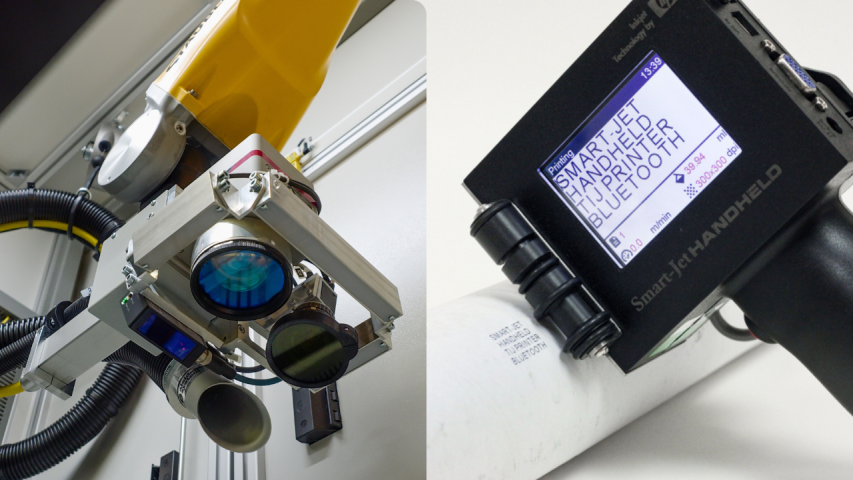
For a given method of marking, a given technology, Lintech is then able to design a single-purpose machine that is able to dispense the tape on the material – unwind it, apply it to the surface of the marked material (glass) and create the desired pattern with a laser beam. Depending on the specification, the loading is either manual or can be designed by machines, manipulators, conveyors, etc.