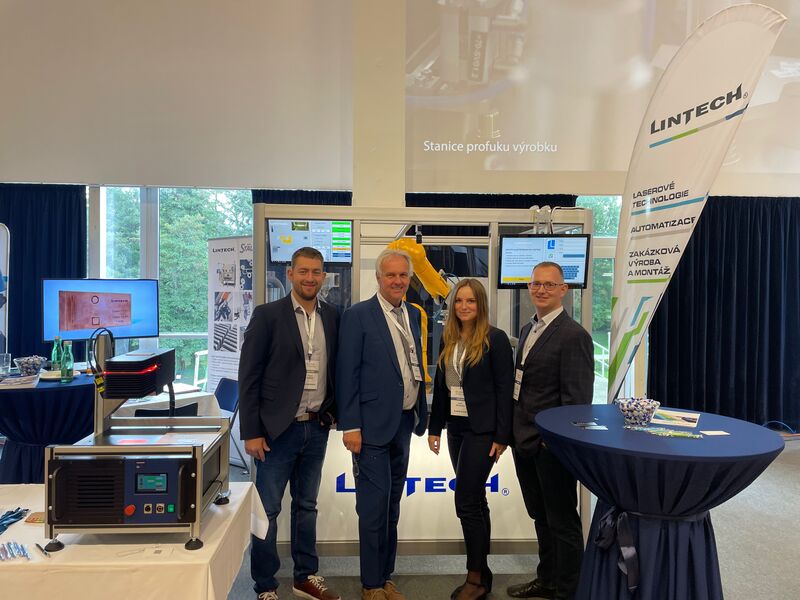
Company LINTECHis in close cooperation with SPIfor many years. As an integrator of laser modules, they use SPI technology mainly for applications laser marking and laser engraving applications. In addition to manufacturing laser systems, they also offer their customers design center services. As one of the few companies on the Czech market, they are able to offer customers a comprehensive solution to laser applications. From consulting, through the design of solutions, to the final delivery of the complete equipment equipped with a laser system. Unlike the competition, LINTECH can design individual solutions according to the specific demand and requirements of the customer.
LINTECH ‘s main field of activity is the automotive sector, which is very widespread in the Czech and Slovak Republic. In the last few years, thanks to the cooperation with a German partner, they have managed to expand their field of activity and currently supply laser systems throughout Europe. One of the main reasons for LINTECH ‘s success is the technical background headed by the application laboratory. Thanks to its own application laboratoryi they are able to keep abreast of new developments that the company’s development centre SPI offers.
A new challenge for LINTECH engineers
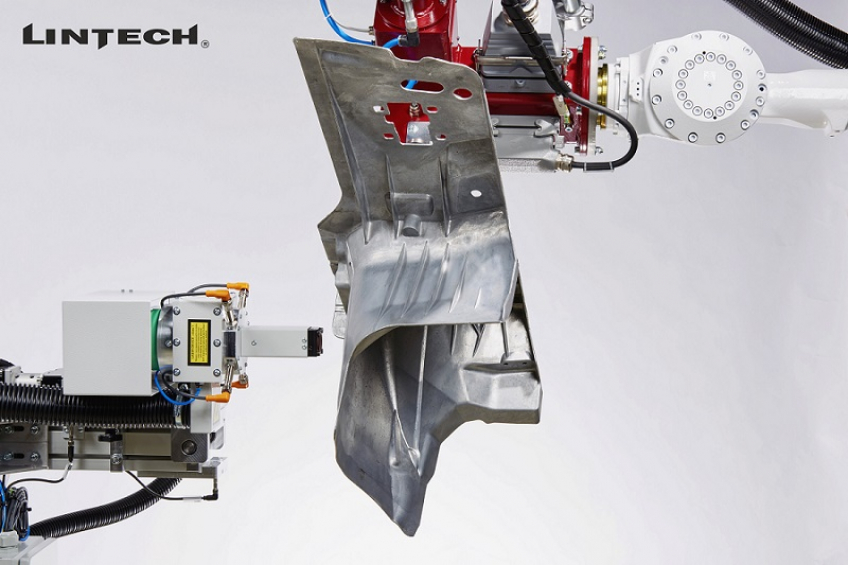
A few years ago, at one of the trade fairs that LINTECH regularly participates in, they got in touch with a new customer who asked them to design a solution for their production. The application was to replace the existing mechanical marking of aluminium castings. The original micro-punch technology performed the marking of castings outside the primary production flow at a separate workstation. Moreover, this workstation was not located at the beginning of the production process, but was preceded by several production operations. The ability to trace back production data based on the marked 2D code was not ideal and insufficient from an efficiency perspective. LINTECH ‘s challenge was to create a laser device working in conjunction with a robotic arm to provide an improved marking process while eliminating the risk of aluminum casting mix-ups caused by manual handling of the casting.
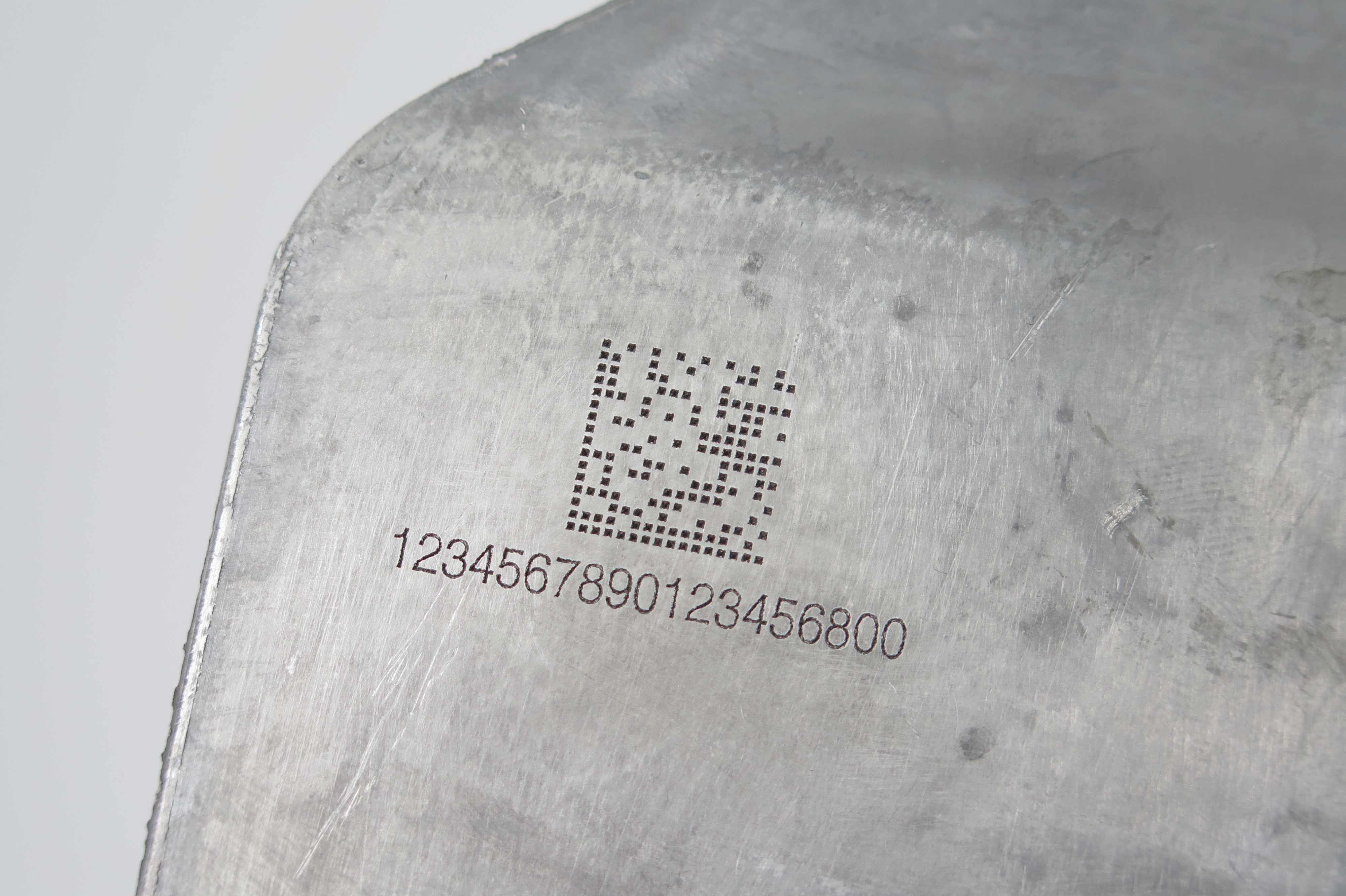
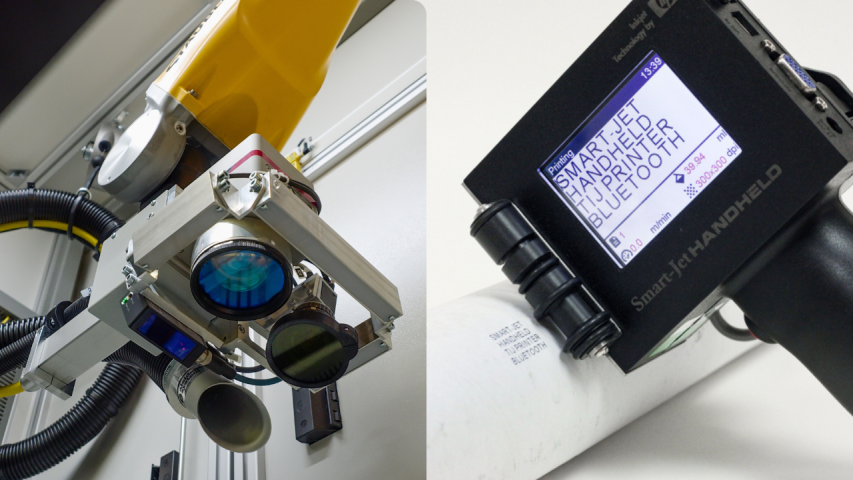
The proposed solution from LINTECH was to create a laser device – laser safety headcompatible with the robotic arm, which engraves thedatamatrix code into the aluminium casting immediately after removal from the casting machine, i.e. at the very beginning of the production process. Marking at this point in the production process allows all the required attributes (exact casting time, temperature,…) to be entered into the marked 2D code, while avoiding confusion of the marked parts.
From a technical point of view, this presented several challenges. The product was removed from the casting machine using a robotic arm. It was then cooled in a water bath. Even after cooling, the temperature of the product was over 100°C. Any residual water on the surface to be processed had to be removed to ensure process stability. At the same time, a scenario was also possible where the product travels from the casting machine directly to the marking and the temperature of the processed part exceeds 200°C. In addition to temperature, the safety aspect had to be addressed as the proposed equipment had to meet safety class 1.
Why choose a laser instead of a microblade?
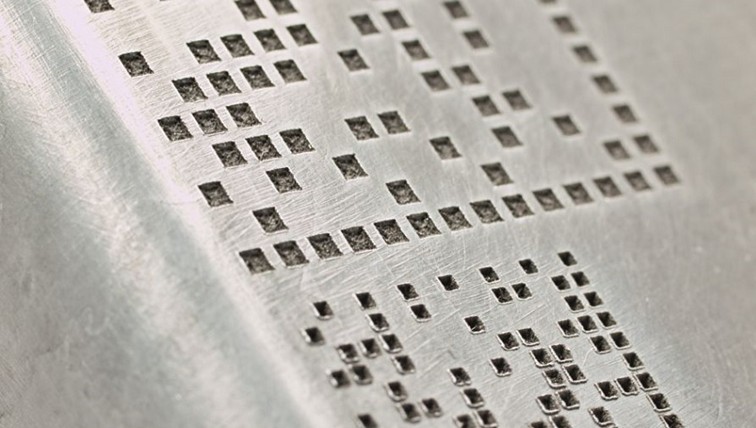
In most cases, the marking of such castings is done using micropoint technology. The micropoint creates small indentations in the castings using a hard carbide tip, with each indentation representing an individual module in the 2D code. The material is pushed by the tip relatively deep below the surface of the part, which ensures high durability of the marked code. The geometry of the dimple depends on the shape of the tip, in particular its grinding angle.
In order for the 2D barcode to be well readable, sufficient contrast between the affected and unaffected material must be created. It is not possible to create contrast by changing the surface colour as standard, as the surface of the part is heavily treated in subsequent operations and the colour fades from the surface. The micropoint does not colour the surface of the material, but creates a shadow inside the stamped pits by illuminating them appropriately to simulate a dark affected surface.
A similar principle for creating 2D code was used with pulsed laser. A sufficiently powerful pulsed laser can engrave modules in aluminium material with similar efficiency to a micro-point. However, unlike the microbode, laser-engraved modules have a number of advantages.
The laser is very accurate and has high repeatability. As a result, a high similarity of the individual modules is achieved, which allows easier reading. The walls of the laser-engraved modules have a much greater perpendicularity, so that shadows form better. The depth of the engraving is dependent on the number of repeats of the engraving process, which is therefore well scalable to achieve the most optimal ratio between time and depth. The laser can engrave even highly complex accompanying patterns or logos with great ease and quality. Unlike micro-point, where contact with the material can cause the embossing tip to break off and create scrap markings, the laser process is very robust and stable. Because the laser does not exert force on the piece during the process, there is no need to hold the part with more force during the marking process, unlike microbonding.
Due to the above described facts, the quality of the codes engraved by pulsed laser during verification measurements was standardly better than in the case of codes formed by microblade, especially after subsequent surface treatments. It turned out that in order to guarantee readability even after surface treatments, an engraving depth of between 0.2 – 0.3 mm is required, which can be achieved with the laser system with the SPI 100P-EP-Z module in about 10 s, while the process time is of course strongly dependent on the size and granularity of the code. Due to its beam quality of less than 1.6 and high average power, the 100P-EP-Z laser proved to be very suitable for the entire operation.
Solution
In order to keep up with the tight production schedule, apulsedlaser with a minimum average power of 70W must be used for engraving ; higher power allows the process time to be further reduced. Based on long term testing, the 100P-EP-Z was selected as the most suitable laser for this application, achieving higher efficiency within the application. Compared to the 70W variant, the increase in efficiency was around 30%. The F-theta 210 lens was used as the focusing optics.
This lens not only has a suitable focal length for the design of our housing, but also has a good ratio between the size of the laser footprint and the areal energy density. This allows for efficient and controlled engraving of large amounts of material per unit time.
There are, of course, certain pitfalls with the use of lasers. However, these can be successfully addressed using appropriate procedures and design measures. The biggest challenge is to comply with the necessary safety standards for working with lasers, where the working beam must be effectively shielded from the surrounding area to meet a Grade I safety class. This is aided by a series of sensors located on a special laser head housing that switch off the laser whenever a leak is detected in the laser area. As laserengraving generates a large volume of debris, this must be intensively extracted during the process so as not to block the laser beam from reaching the engraved surface.
Conclusion
The final form of the compact laser head designed by LINTECH has passed all stress and safety tests. Therefore, it succeeded in the tender at the expense of domestic and foreign competitors. The implementation of the LINTECH cover head and the SPIpulsed fiber laser led to a very positive customer response and the integration of these compact cover heads was successfully extended to the customer’s parent company LINTECH and thus to practically all their subsidiaries worldwide.
Have we worked together before? We can help you expand the capabilities of your facility to suit your needs.
We use cookies and other services for content personalization, advertising and analytics. We share information about your use of the Site with partners who may combine it with other data as a result of your use of their services. By clicking "I Agree", you give us permission to process personal information and cookies for personalized content, advertising and analytics purposes.
Functional and technical (necessary)
Always active
Necessary cookies and services are essential for the proper functioning and display of the website, enabling basic navigation or filling out forms or logging into secure sections.
Předvolby
Technické uložení nebo přístup je nezbytný pro legitimní účel ukládání preferencí, které nejsou požadovány odběratelem nebo uživatelem.
Analytical
Analytics cookies and related services are useful in tracking visitor numbers and identifying traffic sources, allowing us to continually improve the performance of our website.Technické uložení nebo přístup, který se používá výhradně pro anonymní statistické účely. Bez předvolání, dobrovolného plnění ze strany vašeho Poskytovatele internetových služeb nebo dalších záznamů od třetí strany nelze informace, uložené nebo získané pouze pro tento účel, obvykle použít k vaší identifikaci.
Marketing
Some of our advertising partners may set cookies on our website. By granting consent, we may use the cookie or other personal information (phone, email or address) to create profiles based on your interests and then serve relevant advertising on other websites through advertising systems such as Meta Ads, Google Ads and Sklik.