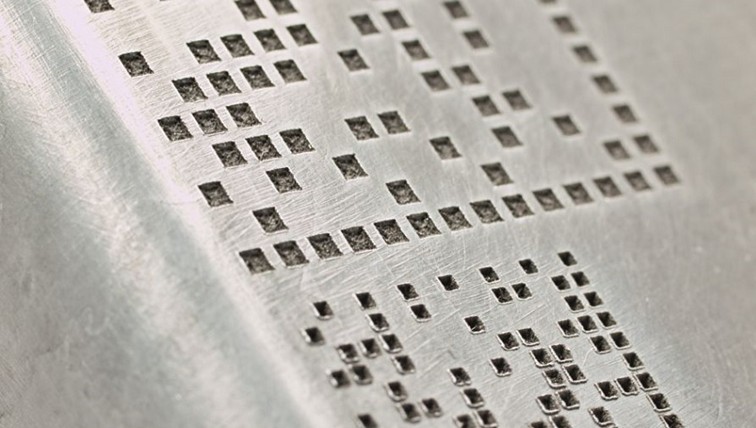
Laser engraving is a very precise type of machining, where after evaporating a certain volume of material, a plastic pattern of the desired shape and dimensions is achieved. In most cases, engraving is carried out at depths of a few hundredths to a few tenths of a mm.
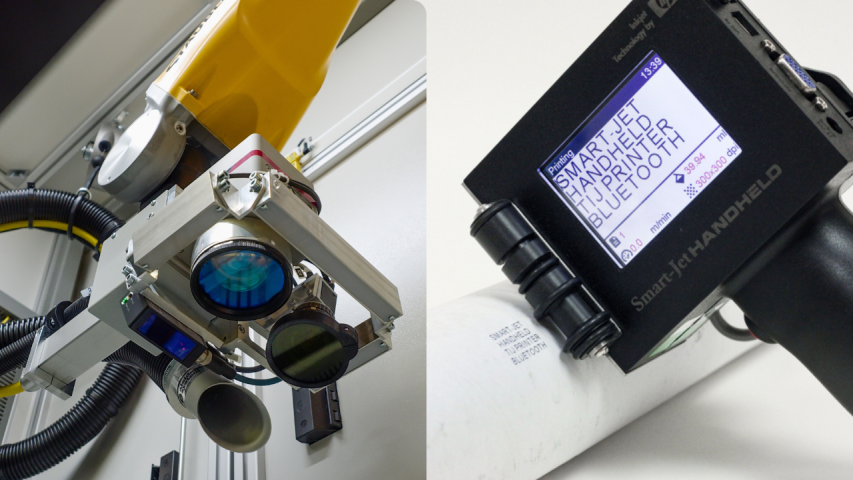
Most often, engraving is done at a single depth only, the pattern then contains only two height levels – the surface level and the level of the engraved area. The data source for the process is a conventional 2D graphic, the depth of engraving in the material is determined by the laser parameters and the number of repetitions of the process. This type of machining is commonly referred to as 2D laser engraving, for which a standard laser assembly consisting of a laser source, a deflecting laser head with focusing optics and control software with a suitable control card can be used.
If the laser beam focus is changed in a controlled way during the process, or even if the direction of the laser beam is changed, this is called 3D engraving. 3D engraving already requires special components – a refocusing optical system that can continuously change the focus of the beam and maintain its focus even when affecting curved surfaces. For more complex applications, we can also encounter positioning systems that carry the laser head within more complex multi-axis systems. There is also a need to have more sophisticated control of the process, where the laser control often has to be additionally properly interfaced with the positioning system control if it is required for the process.
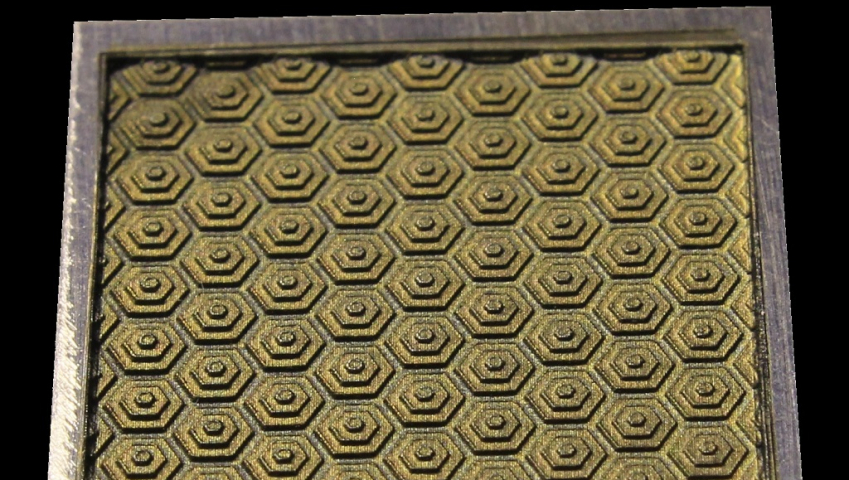
On the borderline between these two applications is the so-called 2.5D engraving. In 2.5D engraving, laser travel is also used to re-focus the system (here usually only in the form of a mechanical Z-axis), but unlike 3D engraving, the control in the third axis is not continuous and is performed when the X and Y axes are stationary. Also, the beam always arrives at the surface in a single direction, ideally perpendicular to the single surface being processed. Given the simpler concept of the device, the control of the whole system is simpler, but there are still elements that are missing in conventional 2D engraving. The control software here allows a 3D model of the target part to be imported (e.g. in STL format), which is then cut into individual layers. Layer by layer, the corresponding graphic is processed and sublimated, always sublimating only a certain depth of material. By overlapping the graphics from the individual layers, deeper engraving is achieved, creating advanced image plasticity. Proper adjustment of the laser process is needed to ensure that the resulting pattern is not too deep or shallow after all layers have been overlaid.
In 2.5D engraving we can find semi-connected transitions between different depths of the engraved pattern, the continuity of the transition depends on the number of layers used. Smaller numbers of layers show more visible “stepping”, higher numbers of layers achieve a better design but increase the process time. A very important stage of the whole process, comparable to the importance of correctly set laser parameters, is the appropriate preparation of the model. There are a number of software that can be used in this respect, be it ArtCam, Inventor, Rhinoceros 3D, etc.