The technique of joining dissimilar metals has long been a challenge for welding engineers and designers, who have often claimed that it is difficult or unfeasible. As many a metallurgist will tell you, it is a combination of physical properties and metallurgical technology that drives weldability.
However, there are many potential applications that require such joints, particularly non-ferrous metals and aluminium to steel alloys.
This is an important process for a number of industries, including electronics, automotive, aerospace and medical, where demand for welding dissimilar metal materials in particular has increased significantly. This is also due to manufacturers looking for cheaper and more productive solutions to this increasingly popular type of manufacturing.
These welds can be conveniently applied with nanosecond pulsed lasers, especially when welding very thin plates. These joints can then be found in consumer electronics and on batteries.
The challenge with this process is that welding dissimilar metals often has problems with heat accumulation and the formation of brittle areas that are prone to cracking. Using a fiber laser for such an application reduces the amount of heat delivered and the size of the area affected, which also reduces cycle time. Another advantage of using a laser is that it can produce precise, controllable, consistent and repeatable welds.
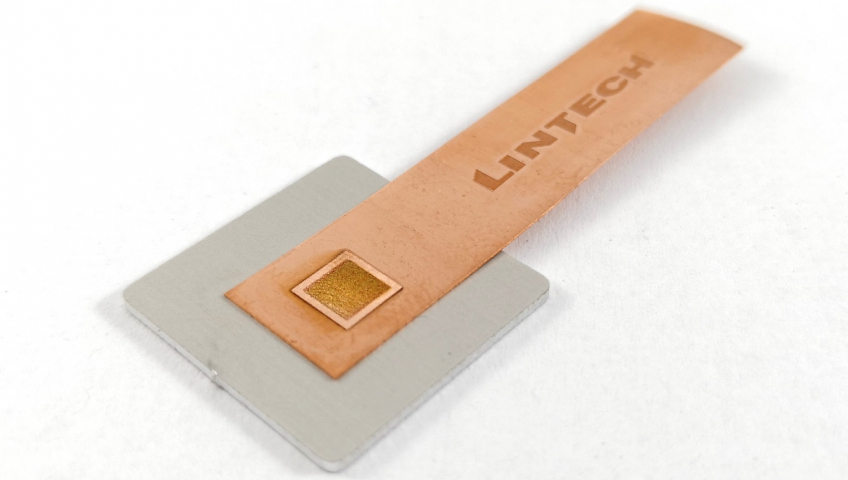
The process uses a 70W P laser source to create spot welds that take approximately 1 second. This creates an extremely strong bond between copper and aluminium. The process is very fast and clean with no oxidizing layers and low electrical resistance.
This is a patented process of SPI Lasers. It is the modules of this manufacturer, a partner of Lintech, that are integrated and used by technicians in laser stations that are manufactured in Domažlice.
The use of nanosecond lasers for joining is advantageous in contrast to conventional welding in that it does not create unnecessarily much melt, so the opportunity for the formation of these unwanted intermetallic phases is suppressed.
Our G4 pulsed lasers operate with pulses of definable characteristics in lengths of units up to hundreds of nanoseconds. This allows the pulse parameters to be adjusted for each stage of the process and provides a tailored solution for achieving efficient welding.
A wide range of process parameter settings offer higher processing quality and maximum flexibility when working with different materials, whether thin aluminium foil or thicker metals. Nanosecond welding is an innovation that has enormous benefits for industry due to its speed and precision.
Our pulsed fiber lasers improve processing speed, operating in pulsed nanosecond mode, making them the perfect industrial manufacturing tool for integration into machines and production lines.
One hundred percent repeatability in other production processes can be achieved thanks to the precision of the LLS-F70P pulsed fiber lasers.