RFID tagging
RFID (Radio Frequency Identification) is a technology where a part is tagged with a chip with an antenna. The reader transmits an electromagnetic signal and reads data from the RFID tag without the need for direct visibility.
Advantages of RFID
- non-contact reading despite dust, oil, paint,
- the ability to read multiple tags in bulk at once,
- data rewritability directly on the chip.
This is why RFID is often deployed in:
- logistics (e.g. identification of pallets and packaging),
- control of circulation units,
- automated warehouses.
RFID issues in parts manufacturing
However, when used directly on metal products or in harsh production conditions, major technical limitations arise.
- Unstable reading in a metallic environment.
- Metal attenuates or reflects radio waves → unreadable or error loading.
- Signal interference by electromagnetic noise.
- The operation of robots, welding equipment or lasers can adversely affect the function of RFID systems.
- Limited data capacity.
- Especially for low-cost tags, the amount of portable information is limited, which is not ideal for advanced traceability.
- High unit costs.
- While the readers are comparable in price to optical devices, the RFID tags themselves represent an extra cost on every part.
- Security risks.
- RFID data can potentially be read remotely without physical access, which may be undesirable in some applications.
Laser marking with 2D code
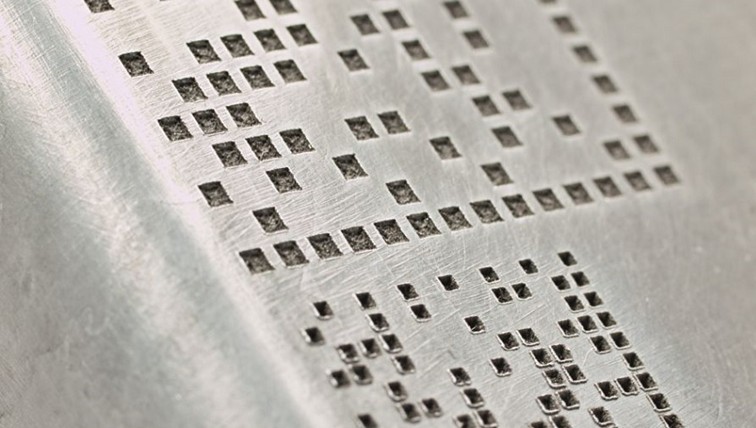
Laser marking creates a permanent structure directly on the surface of the part, usually in DataMatrix (DMC) or QR code format.
Advantages of laser marking
- Permanent marking directly on the part.
- High resistance to chemical and mechanical stress, temperature and liquids.
- Without consumables.
- No label, carrier or medium is needed. The mark is integrated directly into the surface of the part.
- Easy loading with optical readers.
- Compatibility with a wide range of devices on the market.
- High data density.
- 2D codes (especially DMC) can store hundreds of characters.
- Higher level of security.
- The marking is visually visible and cannot be “unseen” without interfering with the part.
The disadvantage is the need for direct visibility for reading and the need to carefully set up the camera system, which is a common part of the solution in production lines.
2D laser marking is now becoming the preferred standard in automotive manufacturing for the direct identification of parts, especially metal and structural components.
The reasons for this are high reliability under operating conditions, compliance with customer requirements and standards, and the long-term legibility of the marking throughout the life of the product.
Conversely, where non-contact or transcribable reading makes sense, such as plastic parts in boxes or tracking of packaging units, RFID technology may be more appropriate.
Are you considering deploying identification technology in your production?
We will be happy to help you design and implement a tailored solution. From technology selection to integration into your production process.