Over time, views on automation and robotics have changed, helped by the pandemic caused by the COVID-19 disease, which has caused production problems for many companies. To prevent the disease from spreading, companies were forced to suspend operations, often for up to 3 months, resulting in hundreds of millions or billions of dollars in financial damage. Most operators were forced to stay home or quarantined and production stagnated.
Currently, manufacturing companies are betting on robotics and automation – resources that can replace scarce and expensive labour. Roboticisation of production processes brings a number of undeniable benefits such as increased productivity, production flexibility and improved quality of the final product. The return on the initial investment will be reaped within a few years.
The combination of robot and laser by LINTECH
LINTECH is a supplier of customized laser equipment. From the design and debugging of the laser application in a well-equipped application laboratory, through the construction of the machine to warranty and post-warranty service. It also offers the possibility of integrating an automated workstation in conjunction with a laser and a Stäubli robotic arm, which is the most optimal in terms of accuracy for the laser.
Thanks to the technological background of LINTECH, we managed to prepare a demonstration of laser welding of steel parts using a robotic arm. The company’s facilities offer a variety of laser modules, from which the 300 W QCW laser was selected as the most suitable for this application. The advantages of laser metal welding are:
- narrow and deep welds easily achieved in a wide range of materials
- laser welding is carried out with very low energy input per unit
length, resulting in minimal deformation, low residual internal welding stresses and a small thermal bandwidth
- the inertia of the laser beam is very short, laser welding is therefore suitable for automation
- the laser beam can weld locally even in hard-to-reach places where it would be difficult with other welding methods
- non-contact welding method
- high weld quality
- higher depth of penetration
- targeted, small and well localised heat load
- welding at high temperatures
- 3D contour processing (high flexibility)
- the result is wear-resistant
Exhibit LIN-bot – automated workplace
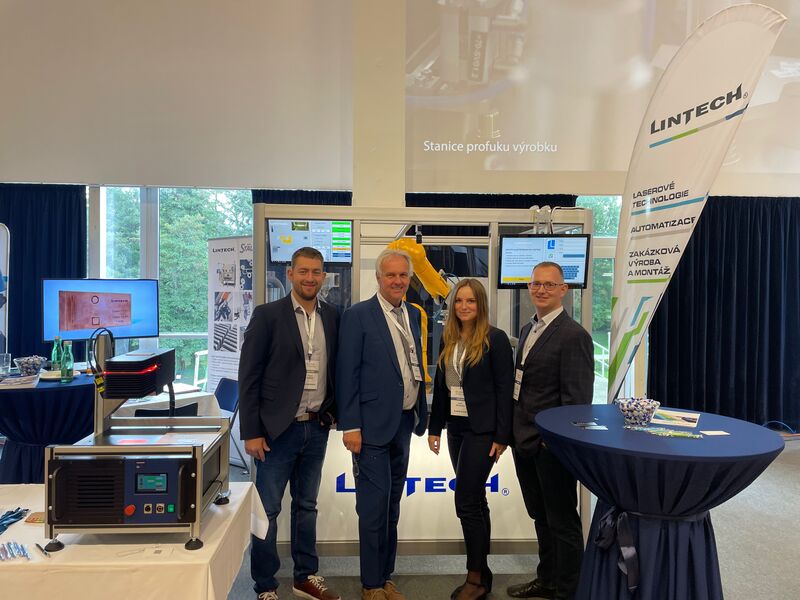
Every year, LINTECH representatives visit the AMPER and MSV trade fairs, where they present the LIN-bot fully automated robotic workstation. This year, unfortunately, due to the pandemic associated with COVID-19, the fairs will not take place and therefore we offer you to watch a short video to better visualize and understand the function of the automated robotic workstation.
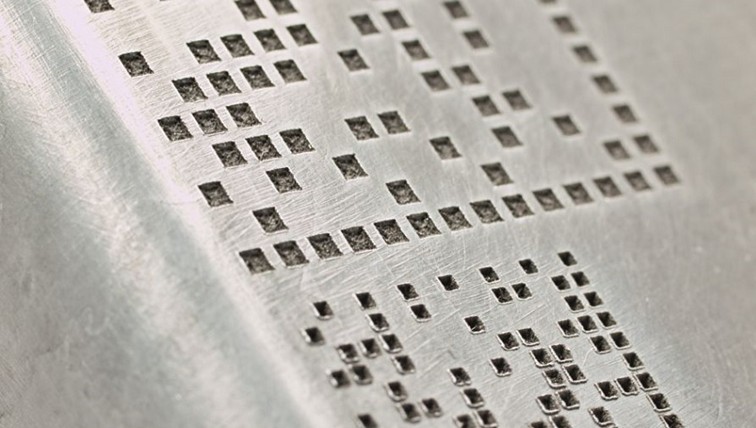
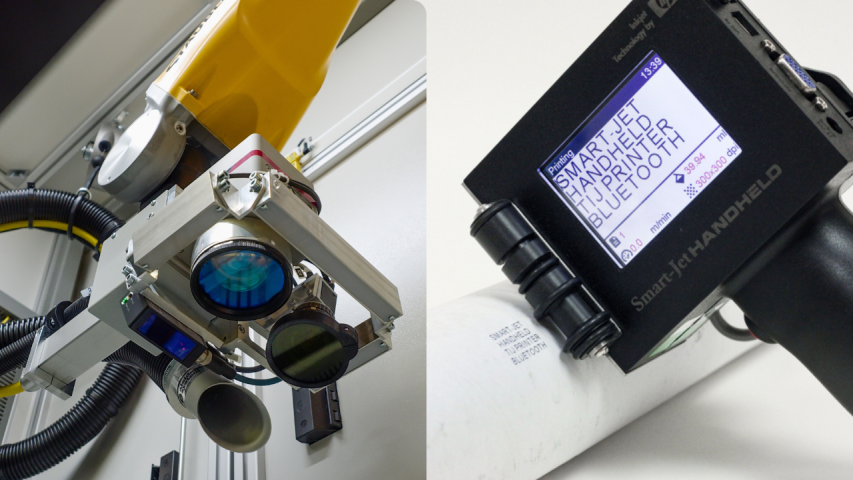
The LIN-bot is used to label anodized labels using a micro-strike device and a laser safety head developed by LINTECH. An integral part of the cell is a camera, thanks to which the robot itself is able to find the arbitrarily based label and start the marking cycle. Using the laser safety head with the LSS – F70 P laser, a QR code is marked on the label, among other things, and its correctness is verified by a reader.