Advantages of inkjet marking
1. Lower acquisition costs
Inkjet printers are an affordable solution, especially for basic applications. They are suitable where long life marking is not required.
2. Wide possibilities of marking different materials
Inkjet allows printing on a wide range of materials – paper, cardboard, plastic, glass, wood, foil. This makes it widely used in the packaging industry, logistics or pharmaceuticals.
3. Option of colour coding
Inkjet technology enables the printing of colour logos, pictograms and graphics, which is advantageous for marketing purposes or consumer packaging labelling, for example.
Disadvantages of inkjet marking
1. Lower output resistance
Ink marking is not permanent. It is susceptible to smudging, mechanical damage or degradation due to humidity and temperature. It is not suitable for marking products in harsh operating conditions.
2. Higher operating costs
The use of inks and consumables (e.g. cleaning fluid) increases long-term costs. The devices also require regular maintenance, including cleaning of the print heads.
Advantages of laser marking
1. Durability and resistance
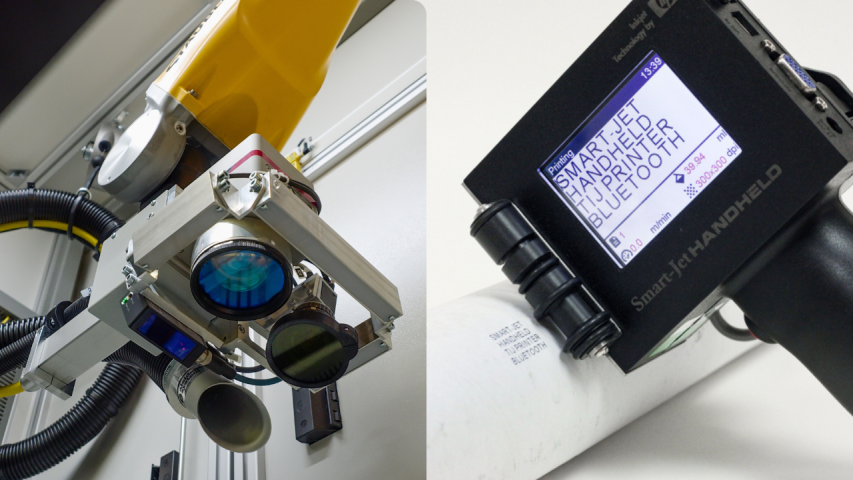
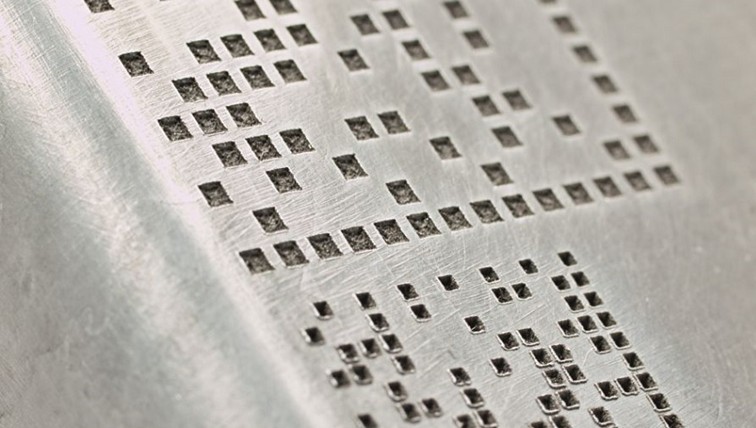
The laser creates a permanent marking that is resistant to abrasion, chemicals and UV light. It is ideal for marking parts in automotive, mechanical or electrical engineering.
2. Without consumables
Laser systems do not require inks or toners. This significantly reduces operating costs and eliminates the need to handle chemicals.
3. Marking accuracy and quality
The laser provides a high level of detail even with small characters, which is important for marking QR codes, serial numbers or datamatrix codes on small components.
Disadvantages of laser marking
1. Higher purchase price
Laser systems are more investment-intensive than inkjet. However, the return on investment is usually assured with long-term and regular operation.
2. Restrictions on certain materials
The laser may not be suitable for marking certain types of thin plastics, dark films or heat sensitive surfaces. In these cases, the appropriate wavelength and technology (e.g. CO₂, fiber, UV) should be selected.
Conclusion
The choice between Inkjet or laser marikng should be based on the specific application, the type of material, the required marking lifetime, investment and operating costs. Inkjet is suitable for flexible and inexpensive marking of packaging materials, while laser is suitable for permanent marking of technical components and products.
Do you need help choosing the right technology?
Contact our team of technical specialists. We will be happy to go over your requirements with you and design the optimal solution tailored to your operation.